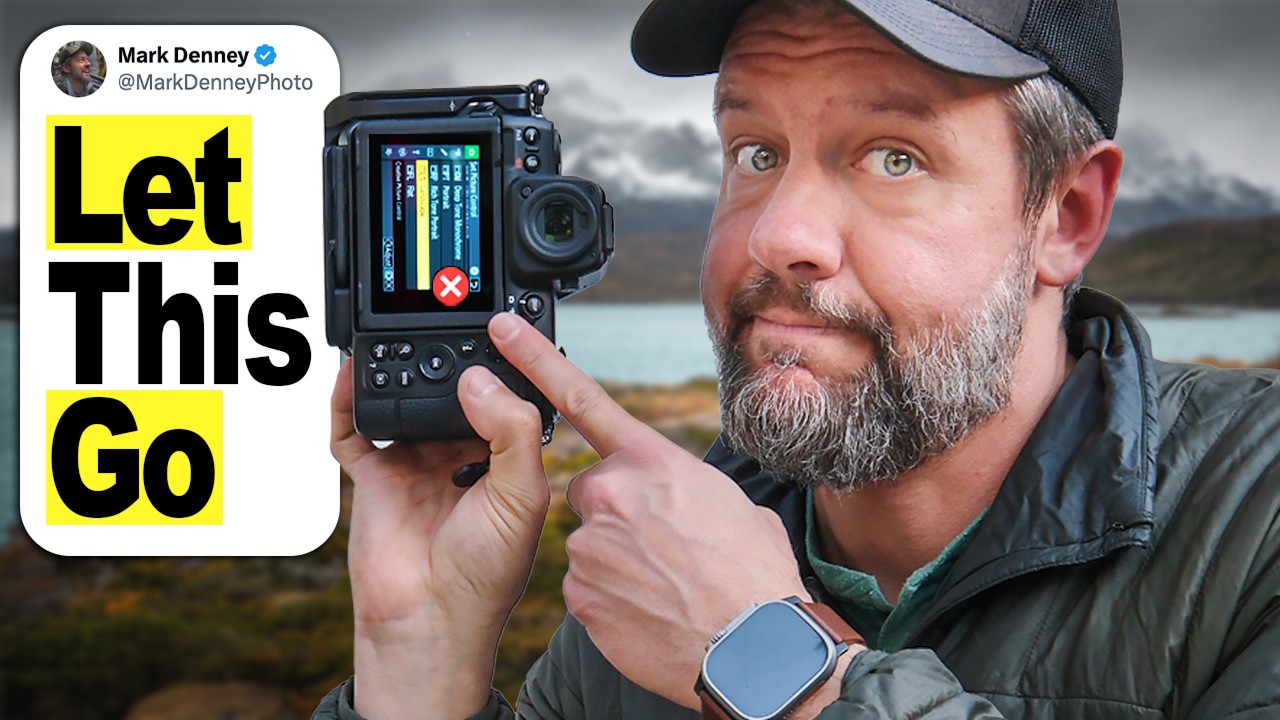
I spent the better part of a decade building systems designed to make images technically perfect. Batch sharpening actions, noise reduction presets tuned to the decimal point, resolution checks baked into every export workflow. That background in commercial studio work trained me to treat every pixel as a deliverable, and for product photography, that discipline pays off. But somewhere along the way I started applying that same obsessive standard to creative work, which is a different thing entirely. When I came across Watch the full tutorial on YouTube, Mark Denney’s breakdown of the 10 things he stopped caring about as a landscape photographer, I recognized almost every item on his list from my own portfolio of unnecessary anxieties.
Denney is a landscape photographer with a decade of hard-won perspective, and what struck me about this video wasn’t that his ideas were radical. It was that they were obvious in hindsight, and I had ignored most of them for years anyway. This isn’t a gear review or a Lightroom walkthrough. It’s closer to a philosophical audit of where serious photographers actually spend their mental energy versus where that energy produces real results. Whether you shoot landscapes on weekends or you’re processing hundreds of images a week like I do, the reframe is worth sitting with.
Step 1: Let Sharpness Be Selective, Not Universal
 Denney explaining the obsession with corner-to-corner sharpness
The first thing Denney stopped chasing was absolute corner-to-corner sharpness in every frame. He’s not saying sharp photos don’t matter. He’s saying the obsession with maximum sharpness in every part of every image stops matching how humans actually see a scene. When you stand in a landscape, your eye doesn’t take in the foreground rock and the distant ridgeline with equal focus simultaneously. There’s natural depth, and there’s a gradient to your attention. Denney argues that a subtle sharpness fall-off toward the back of a frame often reads as more realistic and more immersive than a hyper-sharp front-to-back stack.
Denney explaining the obsession with corner-to-corner sharpness
The first thing Denney stopped chasing was absolute corner-to-corner sharpness in every frame. He’s not saying sharp photos don’t matter. He’s saying the obsession with maximum sharpness in every part of every image stops matching how humans actually see a scene. When you stand in a landscape, your eye doesn’t take in the foreground rock and the distant ridgeline with equal focus simultaneously. There’s natural depth, and there’s a gradient to your attention. Denney argues that a subtle sharpness fall-off toward the back of a frame often reads as more realistic and more immersive than a hyper-sharp front-to-back stack.
The practical shift: stop using focus stacking as a default and start asking whether the scene actually benefits from it. Sometimes the answer is yes. Often it isn’t.
Step 2: Stop Evaluating Images at 100% Magnification
 Browser view at 100% zoom inspecting fine image detail
Pixel peeping was Denney’s second thing to drop, and this one hit close to home. He describes zooming into images at 100% or beyond, hunting for flaws that would never be visible at any normal viewing distance. The question he eventually asked himself: when was the last time he actually enjoyed a photograph at that magnification? The answer was never.
Browser view at 100% zoom inspecting fine image detail
Pixel peeping was Denney’s second thing to drop, and this one hit close to home. He describes zooming into images at 100% or beyond, hunting for flaws that would never be visible at any normal viewing distance. The question he eventually asked himself: when was the last time he actually enjoyed a photograph at that magnification? The answer was never.
This is a real workflow trap. Zoom in to check focus or make a precise local adjustment, absolutely. But using 100% view as the arbiter of whether a photo is good or bad almost guarantees you’ll find a reason to reject something worth keeping. Most of those pixel-level flaws vanish completely the moment you return to a normal view. Judge the image as an image, not as a data file.
Step 3: Recalibrate Your Relationship With Noise
 Denney discussing noise in shadow regions of a landscape photo
Noise reduction is the third area where Denney scaled back his concern. He’s not ignoring noise entirely, but he stopped treating it as something that automatically disqualified an image. His point is that a small amount of natural grain in an image often reads as texture rather than failure, particularly in shadow areas of landscape shots. The attempt to eliminate every trace of it frequently costs detail and creates a processed, plastic look that’s more distracting than the noise itself.
Denney discussing noise in shadow regions of a landscape photo
Noise reduction is the third area where Denney scaled back his concern. He’s not ignoring noise entirely, but he stopped treating it as something that automatically disqualified an image. His point is that a small amount of natural grain in an image often reads as texture rather than failure, particularly in shadow areas of landscape shots. The attempt to eliminate every trace of it frequently costs detail and creates a processed, plastic look that’s more distracting than the noise itself.
The calibration question to ask yourself: is this noise genuinely damaging the image at the size and context it will be displayed, or am I just running noise reduction out of habit?
Step 4: Reassess the Megapixel Ceiling
 Discussion of camera resolution and practical print size requirements
Denney makes a clean, practical argument about megapixels: most photographers have more than they need for every use case they actually have. Unless you’re printing at billboard scale or cropping aggressively as a substitute for proper composition, the sensor resolution on almost any modern camera is sufficient. The upgrade from 24MP to 45MP rarely produces a visibly better image to any actual viewer.
Discussion of camera resolution and practical print size requirements
Denney makes a clean, practical argument about megapixels: most photographers have more than they need for every use case they actually have. Unless you’re printing at billboard scale or cropping aggressively as a substitute for proper composition, the sensor resolution on almost any modern camera is sufficient. The upgrade from 24MP to 45MP rarely produces a visibly better image to any actual viewer.
This matters because megapixel count is one of the primary levers gear marketing pulls on photographers. Denney’s point is that chasing sensor resolution is often a proxy for wanting better photographs, and those aren’t the same pursuit.
Step 5: Decouple Gear From Quality
 Denney reflecting on camera equipment and creative output
The gear conversation is the natural extension of the megapixel one. Denney observed something specific and worth repeating: some of the photographers making his favorite images weren’t particularly focused on equipment, while photographers deeply invested in their kit weren’t consistently producing better work. That gap between gear obsession and output quality is the tell.
Denney reflecting on camera equipment and creative output
The gear conversation is the natural extension of the megapixel one. Denney observed something specific and worth repeating: some of the photographers making his favorite images weren’t particularly focused on equipment, while photographers deeply invested in their kit weren’t consistently producing better work. That gap between gear obsession and output quality is the tell.
Better glass and better bodies do make certain things easier. But they don’t teach you to read light, and they don’t improve your compositional instincts. If upgrading gear feels like the clearest path to better photos, the gear probably isn’t the bottleneck.
Step 6: Disengage From Photography Competitions
 Denney discussing the role of competitions in creative development
Denney eventually stopped caring about photography competitions, not out of bitterness but because he noticed they were shaping what he shot rather than reflecting what he actually wanted to make. Competitions reward a certain kind of image, often dramatic, high-contrast, peak-moment work, and there’s nothing wrong with that aesthetic. But optimizing for a judging panel is a different goal than developing a personal visual language.
Denney discussing the role of competitions in creative development
Denney eventually stopped caring about photography competitions, not out of bitterness but because he noticed they were shaping what he shot rather than reflecting what he actually wanted to make. Competitions reward a certain kind of image, often dramatic, high-contrast, peak-moment work, and there’s nothing wrong with that aesthetic. But optimizing for a judging panel is a different goal than developing a personal visual language.
This is subtle but it compounds. If your shooting decisions are filtered through “would this place well,” you’re outsourcing creative direction to an external standard that may have nothing to do with your own vision.
The Studio Angle: When Technical Standards Are Actually Justified
Here’s my honest caveat from 15 years in commercial work. Some of these things Denney stopped worrying about, I still worry about professionally, and I should. A product image delivered to an ad agency absolutely needs to survive 100% inspection. Noise in a clean-background packshot isn’t grain, it’s a defect. Corner sharpness on an architectural interior matters because the client will zoom in, and that zoom-in is part of the brief.
The difference is context. Commercial deliverables have technical specifications because clients have reproduction requirements. Landscape photography is a creative practice. Applying commercial quality-control standards to creative work doesn’t make the work better, it makes the process heavier and the decision-making more constrained. I keep my batch sharpening presets and my noise-reduction defaults for studio work. When I shoot landscapes, I’ve learned to leave most of that thinking at the door.
The single most useful shift from this video is simple: separate technical evaluation from creative evaluation. Ask whether an image works as a photograph before you ask whether it passes a pixel-level inspection. The technical check is a tool, not the goal.
Watch the full tutorial on YouTube to hear Denney walk through all 10 items in his own words, including a few toward the end of the list that challenge some assumptions about post-processing and editing that are worth hearing directly from him.
Comments
Leave a Comment